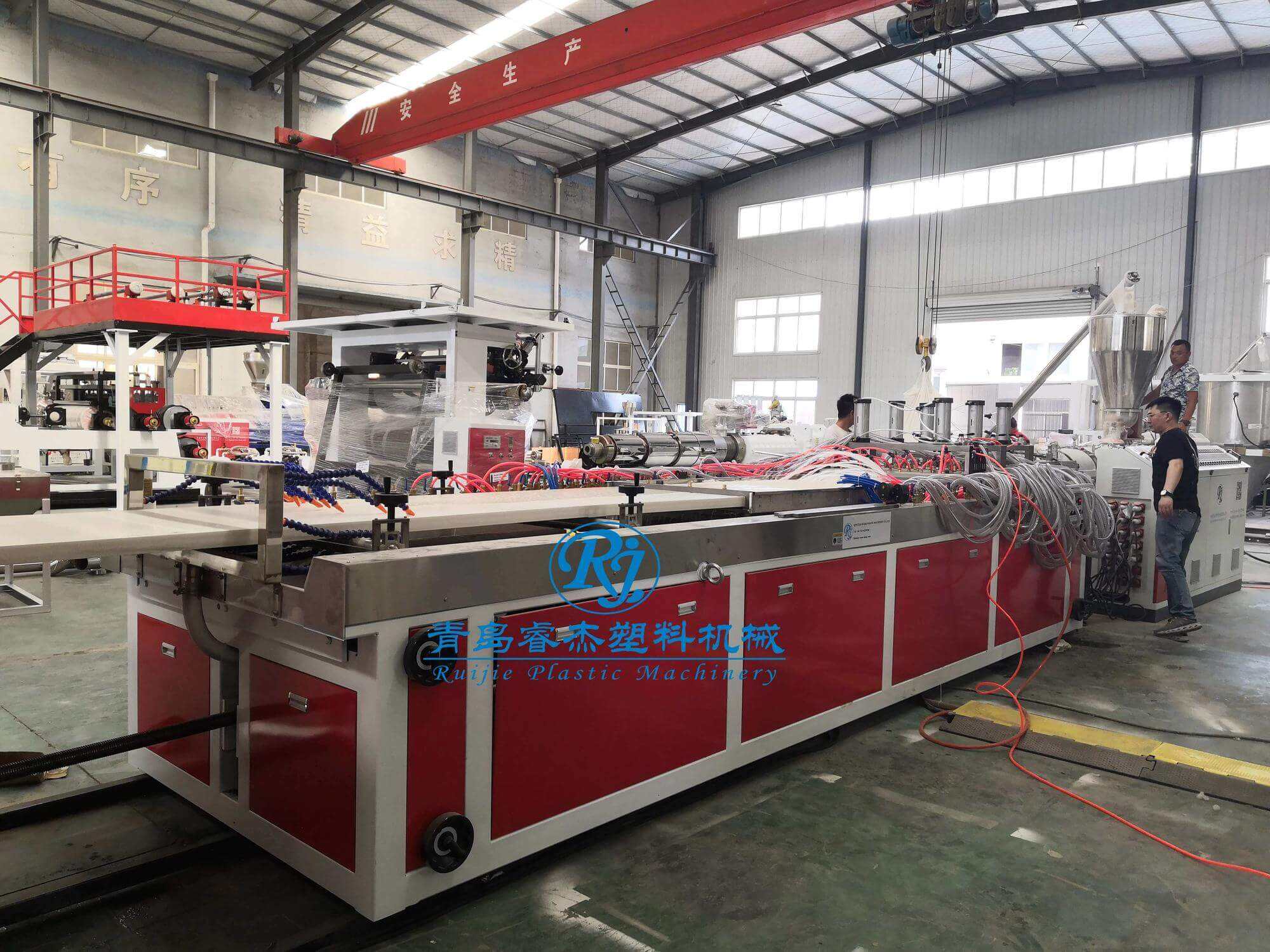
Why Uniform Cooling Is Critical for Dimensional Stability in Plastic Board Production Lines
The Warping Challenge: How Asymmetric Thermal Contraction Drives Edge Curl and Internal Stress
When cooling isn't consistent across the board, it leads to temperature differences that we call delta T (ΔT). These temperature variations cause problems because the polymer contracts at different rates as it solidifies. The edges tend to cool down much quicker than the middle part of the board. This means the edges contract first and actually start pulling the whole board into a curled shape. If there's a difference in cooling speed greater than around 15% between areas, something worse happens inside the material. Stress builds up over time, creating tiny cracks that can show up later during machining operations or while the product is being used. Boards that are over 1.2 meters wide face particular challenges here. When the edges curl more than about 2 millimeters for every meter in height, manufacturers often have to scrap whole batches of production, which obviously impacts both quality control and bottom line costs.
Thermal Gradient Thresholds: Maintaining ΔT < 5°C Across Width to Achieve <0.3 mm/m Warpage
Industry-validated data shows that limiting cross-width ΔT to under 5°C is essential to hold warpage below 0.3 mm/m—a key tolerance for construction-grade panels. At this threshold, differential shrinkage stays below 0.08%. Exceeding 8°C ΔT triggers exponential warpage growth and steep reject-rate increases:
| Thermal Gradient (ΔT) | Warpage (mm/m) | Reject Rate Increase |
|---|---|---|
| < 5°C | ≤ 0.3 | Baseline |
| 5–8°C | 0.3–0.7 | 40% |
| 8°C | ≥ 0.9 | 85%+ |
Achieving consistent ΔT requires precision-calibrated cooling zones with real-time infrared monitoring. Systems without dynamic flow control are especially prone to thermal drift at speeds above 1.5 m/min.
Designing the Cooling Section: Staging, Length, and Medium Selection for Thick Boards
Balancing Surface Integrity and Structural Set: Avoiding Cracking vs. Sag in Boards 25 mm
When working with thick plastic sheets over 25mm, manufacturers deal with conflicting heat requirements. If the material cools down too fast, it can crack on the surface because of thermal stress. But slow cooling creates another problem where the plastic sags before it sets properly. The solution lies in a step-down temperature approach. First, we pull out a lot of heat quickly around 40 to 50 degrees Celsius to harden the outer layers and stop sagging issues. Then comes the slower part where each section drops about 15 to 20 degrees at a time. This helps reduce those pesky internal stresses that cause problems later. For materials like HDPE which form crystals as they cool, keeping the temperature difference between surface and center below 30 degrees is critical to avoid cracks from crystal formation. Using this zoned cooling method actually reduces warping by roughly 40 percent compared to older single stage approaches, all while still getting good surface finish quality.
Physics-Based Sizing: Calculating Optimal Cooling Length Using Thickness and Thermal Diffusivity
The ideal cooling length for plastic parts actually comes down to something called Fourier's heat diffusion principle. The formula looks like this L equals d squared divided by four alpha, where d stands for material thickness and alpha represents thermal diffusivity. Getting this right means the center of the part cools enough so temperatures drop below what we call the glass transition point before it leaves the production line. Most manufacturers add about 20% extra cooling time as a buffer zone. This helps handle those inevitable speed changes during production runs and stops problems like warping or twisting in larger profile extrusions that can happen if parts aren't fully set when they exit the machine.
| Material | Thickness (mm) | α (mm²/s) | Minimum Length (m) |
|---|---|---|---|
| Polypropylene | 30 | 0.11 | 6.8 |
| PVC | 25 | 0.12 | 5.2 |
Water vs. Air Cooling: Performance Trade-offs in Large-Width Plastic Board Production Lines
Heat Transfer Efficiency: Why Water Delivers 3.8× Faster Surface Extraction—with Thermal Shock Risks
Water cooling pulls away surface heat about 3.8 times quicker than forced air does because water conducts heat better and holds more energy per unit volume. This makes production cycles much shorter overall. However there's a catch with this efficiency boost. When things cool down too fast, we often see temperature differences across parts that can hit over 15 degrees Celsius per second in thicker areas above 25 millimeters thick. These sudden changes create tiny cracks inside materials and build up stress points that nobody wants. Plastics like PVC and ABS tend to suffer most from this problem. To deal with it, manufacturers typically set up multiple cooling stages and use special nozzles designed to reduce turbulence. The goal is keeping temperature differences under control, ideally below 5°C for every millimeter thickness. Tests with various polymers have shown this works well to stop those annoying structural flaws from appearing in finished products.
Surface Quality & Cycle Time Implications: Air Cooling for Matte Finishes and Sensitive Polymers
Air cooling offers gentler heat extraction (<3°C/sec), preserving surface integrity in matte-finish boards and reducing warpage in crystalline polymers like HDPE. Though cycle times increase by 40–60% versus water systems, air eliminates water-mark defects and reduces energy consumption by ~30%, per extrusion line benchmarks. It is preferred for:
- Engineering resins like PEEK, where quench-induced brittleness is a concern
- Boards requiring uniform matte aesthetics
- Operations prioritizing energy efficiency over throughput
Material properties and finish requirements—not just cooling speed—must drive medium selection in plastic board production lines.
Precision Flow Engineering: Optimizing Cooling Channel Geometry for Wide-Profile Calibration
Eliminating Centerline Deviation: Diagnosing and Correcting Non-Uniform Flow in Parallel Chill Rolls
When coolant doesn't flow evenly through parallel chill rolls, it leads to centerline deviations especially noticeable on wider production lines. The problem gets worse when there's a temperature difference of more than 8 degrees Celsius across the material width, causing warping that exceeds 0.5 millimeters per meter. Most engineers check for these issues by running thermal maps on roll surfaces and running computer fluid dynamics simulations to pinpoint hotspots. To fix the problem, many facilities change the channel shape from round to square shapes near the edges of boards, which actually increases turbulence by around 40% in those tricky areas. Adjusting channel sizes between 15 and 25 millimeters helps keep pressure losses under 5 kilopascals throughout different sections. Some plants also create separate flow zones so they can adjust temperatures locally where needed. Fine tuning the speed of coolant movement within plus or minus 0.2 meters per second based on how the plastic cools down has been shown to cut dimensional variations dramatically, sometimes reducing them by nearly two thirds in practice.
FAQs
Why is uniform cooling crucial in plastic board production?
Uniform cooling is vital because inconsistent temperatures lead to varying contraction rates, causing edge curling and internal stress, which compromises the dimensional stability and quality of the plastic board.
What are the ideal ΔT threshold values in production?
Maintaining ΔT below 5°C is essential to limit warpage to less than 0.3 mm/m, ensuring structural integrity and minimizing reject rates.
Why is water cooling faster but riskier?
While water cooling is faster due to better heat conduction, it can lead to thermal shock risks, creating internal material cracks and stress points.
Table of Contents
- Why Uniform Cooling Is Critical for Dimensional Stability in Plastic Board Production Lines
- Designing the Cooling Section: Staging, Length, and Medium Selection for Thick Boards
- Water vs. Air Cooling: Performance Trade-offs in Large-Width Plastic Board Production Lines
- Precision Flow Engineering: Optimizing Cooling Channel Geometry for Wide-Profile Calibration
- FAQs
